What a teacher resume must show
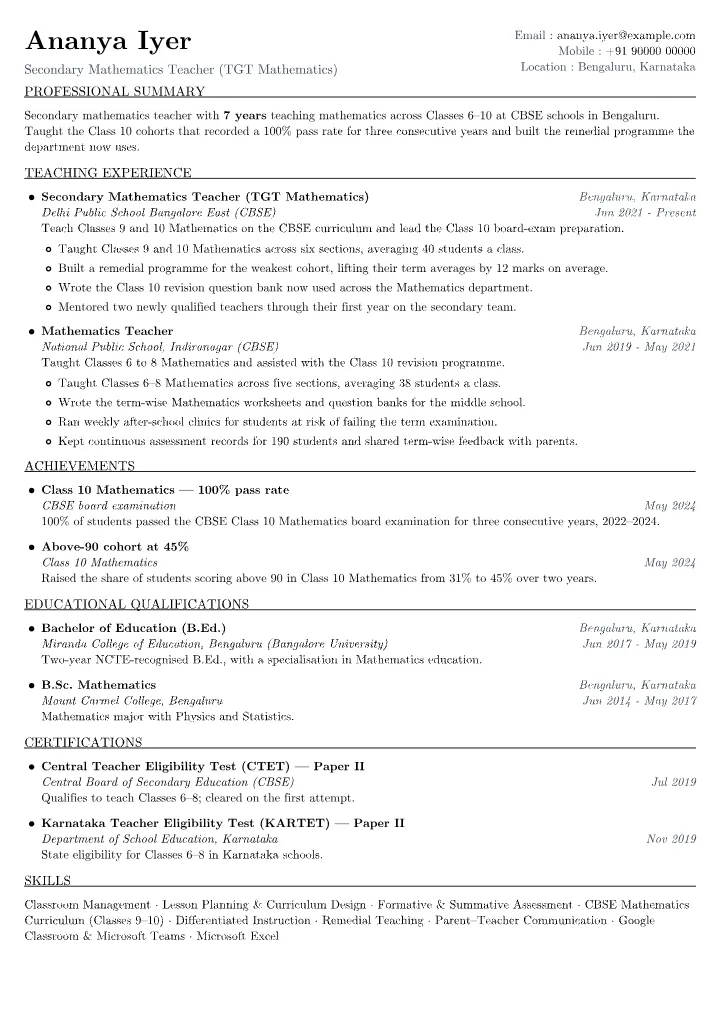
This is a complete, editable sample for a secondary mathematics teacher in Bengaluru — a B.Ed. and CTET, seven years in CBSE schools, and the board results stated the way Indian schools read them. Open it, replace the details with yours, and export.
- The qualification, exactly named
- For Classes 6–10, schools expect a subject degree plus a two-year B.Ed. A teacher-eligibility test — CTET or the state TET (KARTET in Karnataka) — is required to teach Classes 1–8, and most CBSE schools also expect CTET Paper II for TGT posts. For Classes 11–12, a master’s degree plus B.Ed. is the norm.
- The board and the classes you teach
- CBSE, ICSE/ISC or a state board; Classes 6–8, 9–10 or 11–12. TGT, PGT and PRT are different jobs with different classes, so say which one you are and which board you teach.
- Board results, stated honestly
- A CBSE marksheet carries subject marks and grades (A1–E) but no overall percentage, aggregate or division, and there is no merit list. Write your results in aggregate — "100% pass in the Class 10 CBSE Mathematics board examination" — rather than a percentage the board never awarded.
- Teaching load and class size
- How many sections and how many students. "Six sections of Classes 9–10, averaging 40 students a class" tells a principal your workload capacity in one line.
- Curriculum and assessment work you built
- Question banks, worksheets, lesson plans, remedial programmes. Work you wrote and the department still uses is the clearest promotion signal on an Indian teacher CV.
- Language and classroom technology
- Languages you teach in (English, and any regional language), plus the tools schools now use — Google Classroom, Microsoft Teams, smart boards. They appear in many current postings.
Teacher-specific resume tips
Not generic advice — the things that move a teacher application forward.
Lead with the qualification, named exactly
For a secondary post the first check is your degree and your B.Ed., followed by CTET or the state TET. Write "B.Ed. (Bangalore University)" and "CTET Paper II, 2019" rather than "teaching qualification" — Indian schools and principals look for the exact name.
Name the board and the classes
CBSE, ICSE/ISC and the state board are different syllabi, and Classes 6–8, 9–10 and 11–12 are different jobs. Say which board and which classes you teach, so a school can match you to its vacancy.
State board results the way CBSE reports them
CBSE declares an overall pass percentage for the board, but a student marksheet carries subject marks and grades (A1–E) and no overall percentage or division, and there is no merit list. So write aggregate results — "100% pass in Class 10 CBSE Mathematics" or "45% of students scored above 90" — not a percentage the board did not award.
Give your teaching load, not just your title
"Six sections of Classes 9–10, averaging 40 students a class" tells a principal your capacity. Two teachers with the same title may carry 120 students or 240, and Indian schools read that as workload.
Show the curriculum work you wrote
A question bank, a worksheet series or a remedial programme that your department now uses is the strongest promotion signal on an Indian teacher CV. Say what it was and that others adopted it.
Keep personal details off the page
The old biodata format — photo, date of birth, marital status, father’s name, full address — is now widely advised against for private and CBSE schools. Keep your name, phone, email, city and LinkedIn. If a specific school’s form asks for more, follow the form.
Mention the classroom tools schools use
Google Classroom, Microsoft Teams and smart boards appear in many current Indian teaching postings, and a language you can teach in is a genuine scheduling advantage. Put the tools and the languages in your skills line.
A4, one page
A4 is the standard paper size in India and one page is the norm for a teacher under about ten years’ experience; two is fine for an experienced or senior teacher. Length is not the problem; filler is.
What gets teacher resumes rejected
Each of these reads as a red flag to the person doing the hiring.
No B.Ed. or CTET where the school requires them
Most CBSE and state schools ask for a B.Ed. and a teacher-eligibility test. Leaving them off — or describing them vaguely — gets the CV set aside before a principal reads the rest.
A duty list with no results
"Taught Mathematics, prepared lesson plans, corrected notebooks" describes every teacher in India. Without a board result or a class-size figure, there is no reason to shortlist you over the next CV.
A percentage CBSE never printed
CBSE marksheets carry grades, not an official student percentage, and there is no merit list to cite. A precise, invented percentage is easy to disprove and undermines the real numbers around it.
Personal details that invite bias
A photograph, date of birth, marital status or father’s name on a private-school CV is now widely advised against, and it adds nothing a principal needs. Leave them off unless a school’s own form asks for them.
ID numbers on the page
Aadhaar, PAN, bank or passport details do not belong on a resume at all. Under the DPDP Act a resume is personal data, and an ID number on a document a stranger will read is a real risk.
Naming a student or a roll number
A student’s name, photograph or board roll number is never appropriate. Describe results in aggregate — "100% pass", "45% above 90" — and keep every individual out of it.
Teacher resume FAQs
What qualifications do Indian schools require for a teacher?
For Classes 6–10, a bachelor’s degree in the subject plus a two-year B.Ed.; most CBSE and state schools also ask for CTET or the state TET (KARTET in Karnataka). For Classes 11–12 a master’s degree plus B.Ed. is the norm.
Source: NCTE
Should an Indian teacher resume include a photo, date of birth and marital status?
Modern advice is to leave them off. Keep your name, phone, email, city and LinkedIn. The older biodata format still appears in some institutional hiring, so if a school’s own application form asks for those details, follow the form rather than the resume.
Source: Indeed India
How do I state board results on an Indian teacher resume?
In aggregate. A CBSE marksheet carries subject marks and grades (A1–E) but no overall percentage, and there is no merit list. Write "100% pass in the Class 10 CBSE Mathematics board examination" or "45% of students scored above 90" rather than a percentage the board did not award.
Source: CBSE grading
What is the difference between TGT and PGT?
TGT, or Trained Graduate Teacher, covers Classes 6–10; PGT, or Post Graduate Teacher, covers Classes 11–12 and normally needs a master’s degree. PRT is the primary teacher for Classes 1–5. Put the one that matches the post in your headline.
Source: KVS qualifications
Should I list CTET and the state TET on my resume?
Yes — name the test, the paper and the year: "CTET Paper II, 2019". Both are lifetime-valid, so the year alone is enough. Your own registration number is optional, and never list a student’s roll number, an Aadhaar number or a PAN.
How long should an Indian teacher resume be?
One page is the norm for a teacher under about ten years’ experience; two is fine for an experienced or senior teacher, provided every line carries a result rather than a duty. Set it on A4, the standard paper size in India.
Plain-text version
Prefer to start from text? Copy this sample and paste it into any editor.
Ananya Iyer
Secondary Mathematics Teacher (TGT Mathematics)
[email protected] | +91 90000 00000 | Bengaluru, Karnataka

PROFESSIONAL SUMMARY
Secondary mathematics teacher with 7 years teaching mathematics across Classes 6–10 at CBSE schools in Bengaluru. Taught the Class 10 cohorts that recorded a 100% pass rate for three consecutive years and built the remedial programme the department now uses.

TEACHING EXPERIENCE
Secondary Mathematics Teacher (TGT Mathematics) — Delhi Public School Bangalore East (CBSE)
Jun 2021 – Present | Bengaluru, Karnataka
Teach Classes 9 and 10 Mathematics on the CBSE curriculum and lead the Class 10 board-exam preparation.
• Taught Classes 9 and 10 Mathematics across six sections, averaging 40 students a class.
• Built a remedial programme for the weakest cohort, lifting their term averages by 12 marks on average.
• Wrote the Class 10 revision question bank now used across the Mathematics department.
• Mentored two newly qualified teachers through their first year on the secondary team.

Mathematics Teacher — National Public School, Indiranagar (CBSE)
Jun 2019 – May 2021 | Bengaluru, Karnataka
Taught Classes 6 to 8 Mathematics and assisted with the Class 10 revision programme.
• Taught Classes 6–8 Mathematics across five sections, averaging 38 students a class.
• Wrote the term-wise Mathematics worksheets and question banks for the middle school.
• Ran weekly after-school clinics for students at risk of failing the term examination.
• Kept continuous assessment records for 190 students and shared term-wise feedback with parents.

ACHIEVEMENTS
Class 10 Mathematics — 100% pass rate — CBSE board examination
May 2024
100% of students passed the CBSE Class 10 Mathematics board examination for three consecutive years, 2022–2024.

Above-90 cohort at 45% — Class 10 Mathematics
May 2024
Raised the share of students scoring above 90 in Class 10 Mathematics from 31% to 45% over two years.

EDUCATIONAL QUALIFICATIONS
Bachelor of Education (B.Ed.) — Miranda College of Education, Bengaluru (Bangalore University)
Jun 2017 – May 2019 | Bengaluru, Karnataka
Two-year NCTE-recognised B.Ed., with a specialisation in Mathematics education.

B.Sc. Mathematics — Mount Carmel College, Bengaluru
Jun 2014 – May 2017 | Bengaluru, Karnataka
Mathematics major with Physics and Statistics.

CERTIFICATIONS
Central Teacher Eligibility Test (CTET) — Paper II — Central Board of Secondary Education (CBSE)
Jul 2019
Qualifies to teach Classes 6–8; cleared on the first attempt.

Karnataka Teacher Eligibility Test (KARTET) — Paper II — Department of School Education, Karnataka
Nov 2019
State eligibility for Classes 6–8 in Karnataka schools.

SKILLS
Classroom Management · Lesson Planning & Curriculum Design · Formative & Summative Assessment · CBSE Mathematics Curriculum (Classes 9–10) · Differentiated Instruction · Remedial Teaching · Parent–Teacher Communication · Google Classroom & Microsoft Teams · Microsoft Excel