What a nurse resume must show
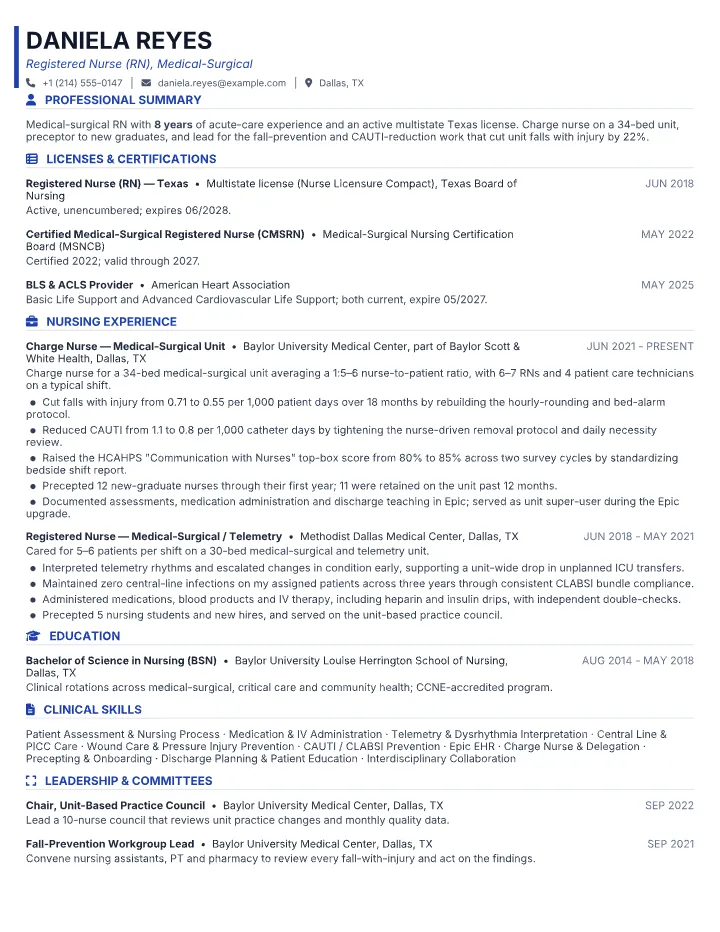
This is a complete, editable sample for a registered nurse on a medical-surgical unit — eight years of acute care, a compact Texas license, and outcomes stated in the units a nurse manager tracks. Open it, replace the details with yours, and export.
- An active RN license, with the state and expiry
- The license is the first thing a nurse recruiter looks for. Give the credential, the issuing board and the expiry date — "Registered Nurse (RN) — Texas, expires 06/2028" — and say whether it is a multistate (compact) or single-state license.
- Unit type and patient population
- "Registered nurse" alone says nothing about fit. Name the setting: medical-surgical, telemetry, ICU, emergency, labor and delivery, pediatrics. Hiring managers hire for a specific unit, not for nursing in general.
- Patient ratio and unit size
- A 1:5–6 ratio on a 34-bed unit is a different job from a 1:8 float pool. Stating the ratio, bed count and shift team size shows the acuity and the workload you carried.
- Certifications with their expiry dates
- BLS and ACLS are usually required; a specialty certification such as CMSRN is preferred. List each with the issuing body and the expiry — a certification with no date reads as expired.
- Nursing-sensitive quality metrics
- Falls with injury, catheter-associated urinary tract infections (CAUTI) and central line-associated bloodstream infections (CLABSI) per 1,000 patient days or catheter days, plus HCAHPS communication scores. These are the indicators nurse managers own, so numbers here read as fluency, not decoration.
- The EHR systems you have used, by name
- Epic, Cerner and Meditech are named explicitly in postings. "Electronic health records" is a non-answer when the unit is on Epic.
- Charge and preceptor scope
- If you have charged a shift or precepted new graduates, say how large the team was and how many nurses you brought through. It is one of the strongest leadership signals a staff-nurse resume can carry.
Nurse-specific resume tips
Not generic advice — the things that move a nurse application forward.
Put the license and its expiry at the top
A recruiter checks for an active, unencumbered RN license before reading anything else. Give the state, whether it is a multistate (compact) license, and the expiry date. Texas RN licenses renew every two years by birth month, so a real expiry date is a signal the rest of the resume is current.
Name the unit, not just the title
A medical-surgical unit, a progressive care unit and an ICU are different jobs with different ratios and skills. Say which one you worked and what patient population it served — "34-bed medical-surgical unit" tells a manager far more than "staff nurse".
Quantify with nursing-sensitive indicators
Falls with injury, CAUTI and CLABSI per 1,000 patient days or catheter days, and HCAHPS communication scores, are the numbers a nurse manager already tracks. "Cut falls with injury from 0.71 to 0.55 per 1,000 patient days" is credible and specific; "improved patient safety" is neither.
State your ratio and team size
A 1:5–6 ratio on a 34-bed unit, with 6–7 RNs and 4 patient care technicians, communicates acuity and leadership scope in one line. Ratios vary by state and unit — California sets ratios in law, Texas does not, so give your actual numbers rather than a general claim.
Name the EHR, because postings do
Epic, Cerner and Meditech are commonly named in acute-care postings, and Epic experience is frequently listed in Dallas–Fort Worth postings. Name the system and say what you did in it — charting, medication administration, discharge teaching.
Show charge and preceptor work as leadership
Charging a shift and precepting new graduates are two of the strongest leadership signals available to a staff nurse. Give the scope — how many nurses and technicians you led, how many new graduates you brought through and how many stayed.
Keep patient information out of it, always
Never put a patient name, initials, room number, exact date of service or any other identifier on a resume. Report only aggregate, unit-level, de-identified data — "falls per 1,000 patient days", not the details of any individual case. Even one vivid, specific patient story can identify someone.
Aim for one page, and go to two only if your experience earns it
One page is the norm for most nurses, and two pages is normal for an experienced or charge nurse — provided every line carries an outcome rather than a duty. Length is not the problem; filler is.
What gets nurse resumes rejected
Each of these reads as a red flag to the person doing the hiring.
No license, or a license with no expiry
A nursing resume without the state license, its type and its expiry date is set aside before a human reads it — the recruiter cannot confirm you are cleared to practice. "Registered nurse" is a title, not proof of licensure.
Duties instead of outcomes
"Assessed patients, administered medications, documented care" describes every nurse alive. If every role on the resume could belong to anyone, there is no reason to interview you.
No unit type or patient population
A manager hiring for a telemetry unit cannot tell whether five years of "nursing experience" was a surgical floor, a clinic or a nursing home. Always name the unit and the population.
A certification with no date
BLS and ACLS expire every two years, and many specialty certifications — CMSRN among them — expire after five. Listing them without an expiry — or listing an expired one — reads as either careless or out of date, and some of them are hard requirements for the posting.
Any patient-identifying detail
A patient name, initials, room number, exact service date or a story specific enough to identify someone is a privacy problem and a professionalism red flag. Keep every metric aggregate and de-identified.
Nurse resume FAQs
Do I need a license to work as a nurse in the US?
Yes. There is no national nursing license — each state issues its own RN license, and you qualify by passing the NCLEX-RN, developed by the NCSBN. Put the state board and your license expiry near the top of the resume.
Source: NCSBN
What does a multistate (compact) license let me do?
A multistate license from a compact home state lets you practice in every other compact state without applying for a new one. Texas is a compact state; California is not. Say whether your license is multistate on the resume.
Source: Nurse Licensure Compact
How often do I renew my nursing license?
license terms and continuing-education rules are set by each state board, so the details differ by state. The one thing that matters on the resume is the expiry date — give it, so a recruiter can see the license is current.
Which certifications belong on a nursing resume?
BLS and ACLS, both from the American Heart Association, are usually required; a specialty certification such as CMSRN is preferred. Give each with its issuing body and expiry — a certification with no date reads as lapsed.
Source: American Heart Association
Can I put patient details on my nursing resume?
No. Never include a patient name, initials, room number, exact date of service or any other identifier. Report only aggregate, de-identified unit data — falls per 1,000 patient days, for example.
How long should a nursing resume be?
One page is standard for most nurses; two is fine for an experienced or charge nurse, provided every line carries an outcome rather than a duty. Length is not the problem; filler is.
Plain-text version
Prefer to start from text? Copy this sample and paste it into any editor.
Daniela Reyes
Registered Nurse (RN), Medical-Surgical
[email protected] | +1 (214) 555-0147 | Dallas, TX

PROFESSIONAL SUMMARY
Medical-surgical RN with 8 years of acute-care experience and an active multistate Texas license. Charge nurse on a 34-bed unit, preceptor to new graduates, and lead for the fall-prevention and CAUTI-reduction work that cut unit falls with injury by 22%.

LICENSES & CERTIFICATIONS
Registered Nurse (RN) — Texas — Multistate license (Nurse Licensure Compact)
Jun 2018 | Texas Board of Nursing
Active, unencumbered; expires 06/2028.

Certified Medical-Surgical Registered Nurse (CMSRN) — Medical-Surgical Nursing Certification Board (MSNCB)
May 2022
Certified 2022; valid through 2027.

BLS & ACLS Provider — American Heart Association
May 2025
Basic Life Support and Advanced Cardiovascular Life Support; both current, expire 05/2027.

NURSING EXPERIENCE
Charge Nurse — Medical-Surgical Unit — Baylor University Medical Center, part of Baylor Scott & White Health
Jun 2021 – Present | Dallas, TX
Charge nurse for a 34-bed medical-surgical unit averaging a 1:5–6 nurse-to-patient ratio, with 6–7 RNs and 4 patient care technicians on a typical shift.
• Cut falls with injury from 0.71 to 0.55 per 1,000 patient days over 18 months by rebuilding the hourly-rounding and bed-alarm protocol.
• Reduced CAUTI from 1.1 to 0.8 per 1,000 catheter days by tightening the nurse-driven removal protocol and daily necessity review.
• Raised the HCAHPS "Communication with Nurses" top-box score from 80% to 85% across two survey cycles by standardizing bedside shift report.
• Precepted 12 new-graduate nurses through their first year; 11 were retained on the unit past 12 months.
• Documented assessments, medication administration and discharge teaching in Epic; served as unit super-user during the Epic upgrade.

Registered Nurse — Medical-Surgical / Telemetry — Methodist Dallas Medical Center
Jun 2018 – May 2021 | Dallas, TX
Cared for 5–6 patients per shift on a 30-bed medical-surgical and telemetry unit.
• Interpreted telemetry rhythms and escalated changes in condition early, supporting a unit-wide drop in unplanned ICU transfers.
• Maintained zero central-line infections on my assigned patients across three years through consistent CLABSI bundle compliance.
• Administered medications, blood products and IV therapy, including heparin and insulin drips, with independent double-checks.
• Precepted 5 nursing students and new hires, and served on the unit-based practice council.

EDUCATION
Bachelor of Science in Nursing (BSN) — Baylor University Louise Herrington School of Nursing
Aug 2014 – May 2018 | Dallas, TX
Clinical rotations across medical-surgical, critical care and community health; CCNE-accredited program.

CLINICAL SKILLS
Patient Assessment & Nursing Process · Medication & IV Administration · Telemetry & Dysrhythmia Interpretation · Central Line & PICC Care · Wound Care & Pressure Injury Prevention · CAUTI / CLABSI Prevention · Epic EHR · Charge Nurse & Delegation · Precepting & Onboarding · Discharge Planning & Patient Education · Interdisciplinary Collaboration

LEADERSHIP & COMMITTEES
Chair, Unit-Based Practice Council — Baylor University Medical Center
Sep 2022 | Dallas, TX
Lead a 10-nurse council that reviews unit practice changes and monthly quality data.

Fall-Prevention Workgroup Lead — Baylor University Medical Center
Sep 2021 | Dallas, TX
Convene nursing assistants, PT and pharmacy to review every fall-with-injury and act on the findings.