What a human resources resume must show
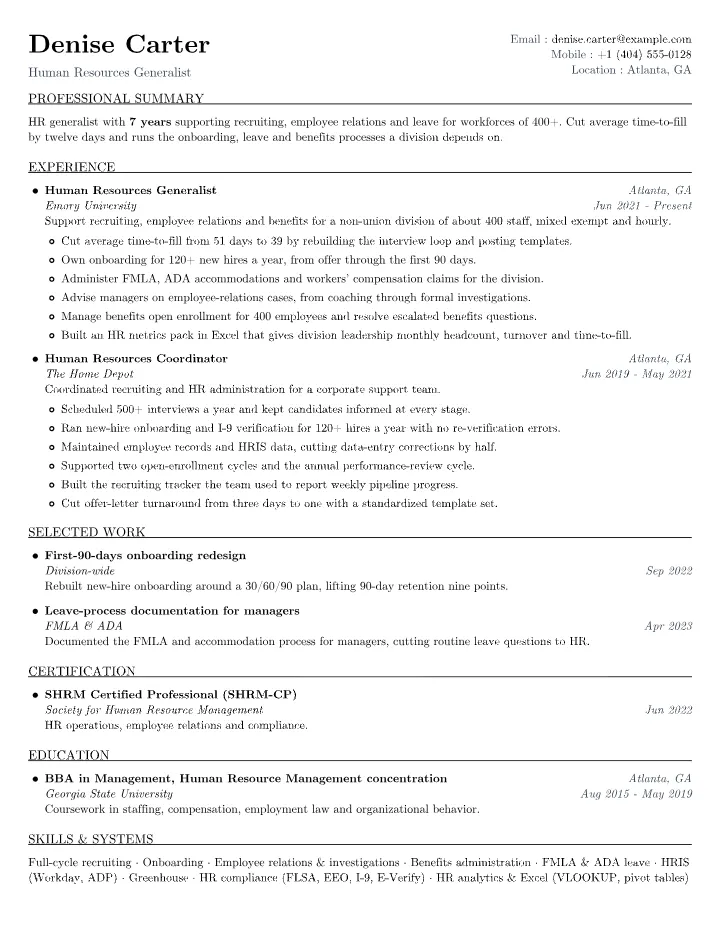
This is a complete, editable sample for an HR generalist — seven years across recruiting, employee relations and leave in Atlanta, a SHRM-CP, and the workforce numbers a hiring manager checks. Open it, replace the details with yours, and export.
- The workforce you supported
- Headcount, locations, union or non-union, exempt and hourly. HR work is sized by the population it serves, so "a division of about 400 staff" tells a hiring manager whether you have done the job at their scale.
- Recruiting outcomes, with numbers
- Time-to-fill, cost-per-hire, offers accepted, requisitions owned. These are the metrics a talent-acquisition team tracks, and a before-and-after on time-to-fill is the strongest recruiting line you can write.
- Employee relations and leave depth
- Investigations, coaching, FMLA, ADA accommodations, workers’ compensation. This is the part of the job that carries legal risk, so naming the casework you own is how you show judgment, not just administration.
- The HRIS by name
- Workday, ADP, SAP SuccessFactors, UKG, BambooHR. Every HR team runs one, and hands-on ownership shortens the ramp. Name the system you administer, not "HR software".
- Certifications with the issuing body
- SHRM-CP or PHR — with the body (SHRM or HRCI) and the year. The credential is voluntary but common, and naming it precisely shows you are current in the field.
- Retention and employee-experience impact
- Turnover, retention, engagement, onboarding completion. HR exists to keep good people, so a movement in retention or onboarding reads as the outcome the role is really measured on.
Human Resources-specific resume tips
Not generic advice — the things that move a human resources application forward.
Size the population first
HR is scaled by the workforce it supports. "Supported 400 staff across two locations" tells a hiring manager more in one line than a paragraph of duties, because the same title can mean 50 people or 5,000.
Make time-to-fill the recruiting headline
Time-to-fill and cost-per-hire are the two numbers talent acquisition lives on. A before-and-after — "cut average time-to-fill from 51 days to 39" — is the strongest recruiting line you can put on the page.
Show the casework that carries legal risk
FMLA, ADA accommodations, workers’ compensation and employee-relations investigations are where HR judgment matters most. Naming them tells a hiring manager you can be trusted with the cases that could become a legal problem.
Name the HRIS, because every team runs one
Workday, ADP, SuccessFactors, UKG, BambooHR. Hands-on ownership of the system — not just "used" it — is what shortens the ramp, so say what you administered and what you improved.
Give the certification precisely
SHRM-CP is issued by SHRM; PHR by HRCI. State the credential, the body and the year. It is a voluntary credential, but a precise one still signals currency, especially against candidates who have neither.
Show a retention or onboarding result
The end goal of HR is keeping and developing good people. A turnover reduction, a retention gain, an onboarding completion rate all point at the outcome, rather than the process, of your work.
Protect every employee detail
Never put an individual’s name, a medical or leave reason, a diagnosis, or an investigation detail on the page. Use aggregate, role-level figures only — "managed 30+ employee-relations cases" — because HR confidentiality is a core part of the job.
One page is the norm
One page is standard for a generalist; use a second only if you are listing a management scope or a long certification list. Length is not the problem; padding is.
What gets human resources resumes rejected
Each of these reads as a red flag to the person doing the hiring.
Duties with no workforce numbers
"Recruited, onboarded, supported employees" describes every HR generalist. Without headcount, time-to-fill or turnover figures, a hiring manager cannot tell the scale or the impact of your work.
Naming an employee or a leave detail
A name, a diagnosis or the reason for someone’s leave is a confidentiality breach, and it reads as a failure of judgment in the one role where discretion is the core skill. Keep every example aggregate.
Listing employment laws without casework
Anyone can list FMLA, ADA and EEO. What matters is the casework behind them — the accommodations you ran, the investigations you handled — so attach the laws to what you actually did.
"HR software" with no system
Every HR team runs Workday or ADP or UKG. If you have administered one, name it; the generic phrase tells a hiring manager you may need training you do not actually need.
A perfect retention claim
A 100% retention rate is not believable and invites the question that ends the conversation. Real improvement — "reduced turnover from 18% to 11%" — is far more convincing and far safer.
Personality adjectives instead of evidence
"Approachable, discreet, a people person" is a list of claims. Replace each with a number or a specific case: headcount, time-to-fill, cases handled.
Human Resources resume FAQs
Do I need a certification to work in HR?
No. HR is not a licensed profession and the certifications are voluntary. SHRM-CP and SHRM-SCP are issued by SHRM; PHR and SPHR by HRCI. Name the credential and its body — a bare "HR certified" says nothing.
Source: SHRM
What does the SHRM-CP require?
Nothing but the exam fee — candidates do not need an HR job title, a degree or previous HR experience to sit it. That is why it is common on early-career resumes, where it signals commitment to the field.
Source: SHRM
Which HRIS should an HR resume name?
The one you have administered: Workday, ADP, SAP SuccessFactors, UKG or BambooHR. Every HR team runs one, and hands-on ownership — not just "used it" — is what shortens the ramp, so name it and say what you did in it.
Source: O*NET
Which metrics belong on an HR resume?
Time-to-fill, cost-per-hire, turnover or retention, and the headcount you supported. These are the numbers a talent-acquisition or HR leader already tracks, so a before-and-after reads as fluency rather than decoration.
Source: SHRM benchmarking
Can I name employees or leave details on an HR resume?
Never. No individual’s name, medical or leave reason, diagnosis or investigation detail. Use aggregate, role-level figures only — "managed 30+ employee-relations cases" — because confidentiality is the core of the job.
How long should an HR resume be?
One page is standard for a generalist; use a second only if you are listing a management scope or a long certification list. Length is not the problem; padding is.
Plain-text version
Prefer to start from text? Copy this sample and paste it into any editor.
Denise Carter
Human Resources Generalist
[email protected] | +1 (404) 555-0128 | Atlanta, GA

PROFESSIONAL SUMMARY
HR generalist with 7 years supporting recruiting, employee relations and leave for workforces of 400+. Cut average time-to-fill by twelve days and runs the onboarding, leave and benefits processes a division depends on.

EXPERIENCE
Human Resources Generalist — Emory University
Jun 2021 – Present | Atlanta, GA
Support recruiting, employee relations and benefits for a non-union division of about 400 staff, mixed exempt and hourly.
• Cut average time-to-fill from 51 days to 39 by rebuilding the interview loop and posting templates.
• Own onboarding for 120+ new hires a year, from offer through the first 90 days.
• Administer FMLA, ADA accommodations and workers’ compensation claims for the division.
• Advise managers on employee-relations cases, from coaching through formal investigations.
• Manage benefits open enrollment for 400 employees and resolve escalated benefits questions.
• Built an HR metrics pack in Excel that gives division leadership monthly headcount, turnover and time-to-fill.

Human Resources Coordinator — The Home Depot
Jun 2019 – May 2021 | Atlanta, GA
Coordinated recruiting and HR administration for a corporate support team.
• Scheduled 500+ interviews a year and kept candidates informed at every stage.
• Ran new-hire onboarding and I-9 verification for 120+ hires a year with no re-verification errors.
• Maintained employee records and HRIS data, cutting data-entry corrections by half.
• Supported two open-enrollment cycles and the annual performance-review cycle.
• Built the recruiting tracker the team used to report weekly pipeline progress.
• Cut offer-letter turnaround from three days to one with a standardized template set.

SELECTED WORK
First-90-days onboarding redesign — Division-wide
Sep 2022
Rebuilt new-hire onboarding around a 30/60/90 plan, lifting 90-day retention nine points.

Leave-process documentation for managers — FMLA & ADA
Apr 2023
Documented the FMLA and accommodation process for managers, cutting routine leave questions to HR.

CERTIFICATION
SHRM Certified Professional (SHRM-CP) — Society for Human Resource Management
Jun 2022
HR operations, employee relations and compliance.

EDUCATION
BBA in Management, Human Resource Management concentration — Georgia State University
Aug 2015 – May 2019 | Atlanta, GA
Coursework in staffing, compensation, employment law and organizational behavior.

SKILLS & SYSTEMS
Full-cycle recruiting · Onboarding · Employee relations & investigations · Benefits administration · FMLA & ADA leave · HRIS (Workday, ADP) · Greenhouse · HR compliance (FLSA, EEO, I-9, E-Verify) · HR analytics & Excel (VLOOKUP, pivot tables)