What a graphic designer resume must show
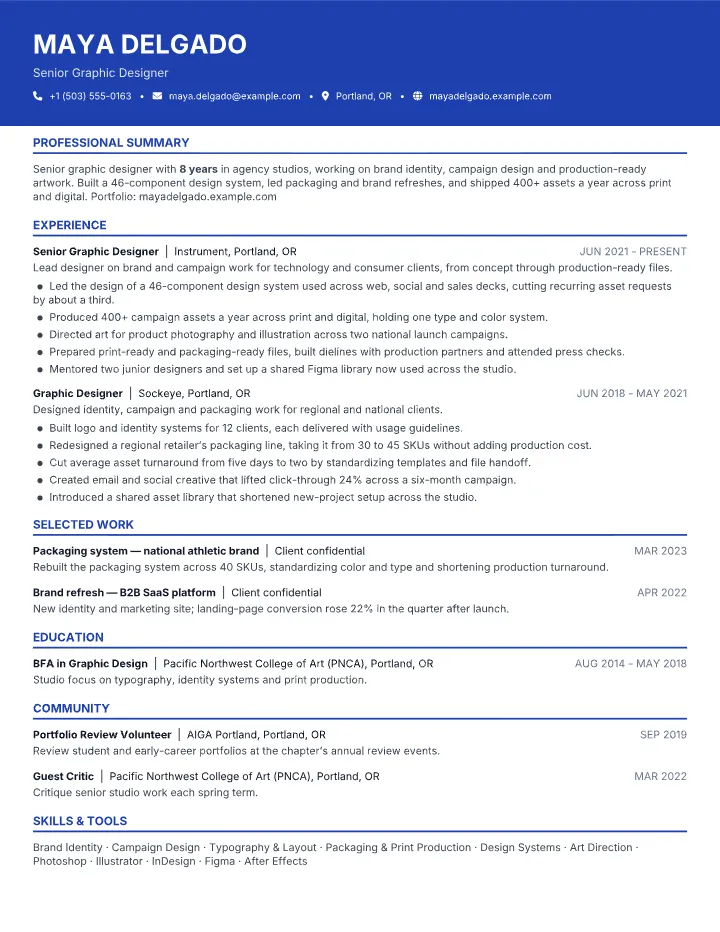
This is a complete, editable sample for a senior graphic designer — eight years in Portland agencies, a portfolio front and center, and work described by what it changed rather than which software made it. Open it, replace the details with yours, and export.
- A portfolio link, easy to find and click
- Designers are hired on the portfolio, and a posting almost always asks for it. Put the URL in the header and repeat it in the body as readable text, so it is clickable in the PDF and impossible to miss.
- Typography and layout that hold up to scrutiny
- A design reviewer reads the resume as a piece of design. Real type choices, clean hierarchy and consistent spacing signal craft before a single line is read — and sloppiness is noticed immediately.
- Tools named individually
- Postings name Photoshop, Illustrator, InDesign and Figma. "Adobe Creative Suite" as a single line says very little; name each tool you use at a professional level.
- Delivered work with its outcome
- Campaigns, packaging, identity systems, design systems — each described with what changed: conversion, turnaround, asset volume. A portfolio shows the work; the resume has to show the result.
- Production fluency
- Print-ready and packaging-ready files, dielines, prepress and press checks. Many designers work only in screen mockups, so demonstrated production skill separates candidates for print and packaging roles.
- Your role on team work
- Design is collaborative. Say what you led, art-directed or contributed — "designed 12 of 40 components", "art-directed the shoot". Never present a team project, or another designer’s work, as solely yours.
- Range across media
- Identity, packaging, campaign, social, print. Studios and in-house teams hire for breadth as much as depth, so show the different kinds of work you have shipped rather than one narrow specialty.
Graphic Designer-specific resume tips
Not generic advice — the things that move a graphic designer application forward.
The portfolio gets the interview — the resume has to earn the look
For a designer the portfolio is the main event, and the resume is read second — but it is read closely, by people who judge layout for a living. Keep it clean, typographic and specific. A designer hiring a designer notices sloppiness immediately.
Put the portfolio URL where it is impossible to miss
A personal domain is best; a Behance or Dribbble profile is fine if that is what you keep current. Put it in the header and repeat it in the body as plain text, so it still works when the resume is printed, screenshotted or copied out of a PDF.
Name the tools, not the suite
Postings list Photoshop, Illustrator, InDesign and Figma by name, and Figma is now standard in most studios. Name each tool you actually work in at a professional level rather than hiding behind "Adobe Creative Suite".
Show delivered work with the number attached
A campaign, a packaging range, an identity system, a design system — say what it was and what it changed. As a rule of thumb, conversion lifts in the 10–30% range are credible when scoped to a specific project; a three-figure percentage needs a named case behind it.
State your role on every team project
Design work is usually collaborative, and claiming a team’s output as your own is the fastest way to fail a reference check. Say what you led, art-directed or contributed — and anonymize confidential work rather than naming the client, unless you are cleared to credit it. If even the work’s existence is under NDA, leave it off entirely.
Production fluency is an underrated differentiator
Print-ready and packaging-ready files, dielines, prepress and press checks are named in many postings and missing from many portfolios. If you can take artwork all the way to press, say so — it widens the roles you fit.
Show the range you can actually deliver
A studio or in-house team hires for breadth as much as depth. List the kinds of work you have shipped — identity, packaging, campaign, social, editorial — so a hiring manager can see where you would slot in on their projects.
Do not over-design the resume itself
A designed resume signals craft, but infographic resumes, skill bars and icon ratings read as a red flag to design hiring managers. Clean hierarchy, real typography and a single column beat decoration.
One page, unless the work earns a second
A design reviewer expects one page under about ten years of experience; two only if every line carries a shipped deliverable and an outcome. Length is not the problem; padding is.
What gets graphic designer resumes rejected
Each of these reads as a red flag to the person doing the hiring.
No portfolio link
A designer’s resume without a portfolio URL is set aside early — the work is the point, and the posting usually says the portfolio is required. A link that is hard to find, or not clickable, may as well not be there.
A resume that is a design exercise first and a resume second
Infographics, skill bars and decorative flourishes get in the way of the information. A reviewer wants your type, layout and experience in a legible hierarchy — not a poster with a job history hidden inside it.
Tools listed as "Adobe Creative Suite"
One line for the whole suite tells a hiring manager very little. Name Photoshop, Illustrator, InDesign and Figma individually, and only the ones you genuinely work in.
Work with no stated role
Listing a team project as though you did it alone reads as a claim you cannot back. State your part — led, art-directed, contributed — or leave it off.
Skill bars and icon ratings
"Photoshop 90%" is meaningless and tells a hiring manager nothing they can use. A list of the tools you work in professionally is stronger and reads as more confident.
Clients or work you are not cleared to show
Naming a client without permission, or showing unreleased work under NDA, is a professionalism and legal problem. Anonymize — "a national athletic brand" — unless the work is public and you are cleared to credit it.
Graphic Designer resume FAQs
Do I need a license to work as a graphic designer?
No. Graphic design is not a licensed profession in the US, so no state credential is required. Hiring is portfolio-led, and the software you work in is what a posting asks for.
Source: US Bureau of Labor Statistics
Which design tools should I list?
Name them individually: Illustrator, Photoshop, InDesign and Figma. "Adobe Creative Suite" as one line says very little, and the specific tools are what a posting and a reviewer look for.
Source: O*NET hot technologies
Do I need a degree to be a graphic designer?
A bachelor’s in graphic design or a related field is common but not required, and no license exists. A strong portfolio and the right tools matter more than the degree line for most studio and in-house roles.
Can I show client work on my resume or portfolio?
Only if you are cleared to. Name the client only with permission; otherwise anonymize — "a national athletic brand" — and keep unreleased or NDA work off entirely. Never present a team’s work as solely your own.
How long should a graphic design resume be?
One page is standard under about ten years of experience; two is fine for a senior or lead designer if every line carries work and an outcome. Length is not the problem; padding is.
Should I design my resume, or keep it plain?
Keep it clean and typographic. A designed resume signals craft, but infographic resumes, skill bars and icon ratings read as a red flag to design hiring managers. Real typography and hierarchy beat decoration.
Plain-text version
Prefer to start from text? Copy this sample and paste it into any editor.
Maya Delgado
Senior Graphic Designer
[email protected] | +1 (503) 555-0163 | Portland, OR | mayadelgado.example.com

PROFESSIONAL SUMMARY
Senior graphic designer with 8 years in agency studios, working on brand identity, campaign design and production-ready artwork. Built a 46-component design system, led packaging and brand refreshes, and shipped 400+ assets a year across print and digital. Portfolio: mayadelgado.example.com

EXPERIENCE
Senior Graphic Designer — Instrument
Jun 2021 – Present | Portland, OR
Lead designer on brand and campaign work for technology and consumer clients, from concept through production-ready files.
• Led the design of a 46-component design system used across web, social and sales decks, cutting recurring asset requests by about a third.
• Produced 400+ campaign assets a year across print and digital, holding one type and color system.
• Directed art for product photography and illustration across two national launch campaigns.
• Prepared print-ready and packaging-ready files, built dielines with production partners and attended press checks.
• Mentored two junior designers and set up a shared Figma library now used across the studio.

Graphic Designer — Sockeye
Jun 2018 – May 2021 | Portland, OR
Designed identity, campaign and packaging work for regional and national clients.
• Built logo and identity systems for 12 clients, each delivered with usage guidelines.
• Redesigned a regional retailer’s packaging line, taking it from 30 to 45 SKUs without adding production cost.
• Cut average asset turnaround from five days to two by standardizing templates and file handoff.
• Created email and social creative that lifted click-through 24% across a six-month campaign.
• Introduced a shared asset library that shortened new-project setup across the studio.

SELECTED WORK
Packaging system — national athletic brand — Client confidential
Mar 2023
Rebuilt the packaging system across 40 SKUs, standardizing color and type and shortening production turnaround.

Brand refresh — B2B SaaS platform — Client confidential
Apr 2022
New identity and marketing site; landing-page conversion rose 22% in the quarter after launch.

EDUCATION
BFA in Graphic Design — Pacific Northwest College of Art (PNCA)
Aug 2014 – May 2018 | Portland, OR
Studio focus on typography, identity systems and print production.

COMMUNITY
Portfolio Review Volunteer — AIGA Portland
Sep 2019 | Portland, OR
Review student and early-career portfolios at the chapter’s annual review events.

Guest Critic — Pacific Northwest College of Art (PNCA)
Mar 2022 | Portland, OR
Critique senior studio work each spring term.

SKILLS & TOOLS
Brand Identity · Campaign Design · Typography & Layout · Packaging & Print Production · Design Systems · Art Direction · Photoshop · Illustrator · InDesign · Figma · After Effects