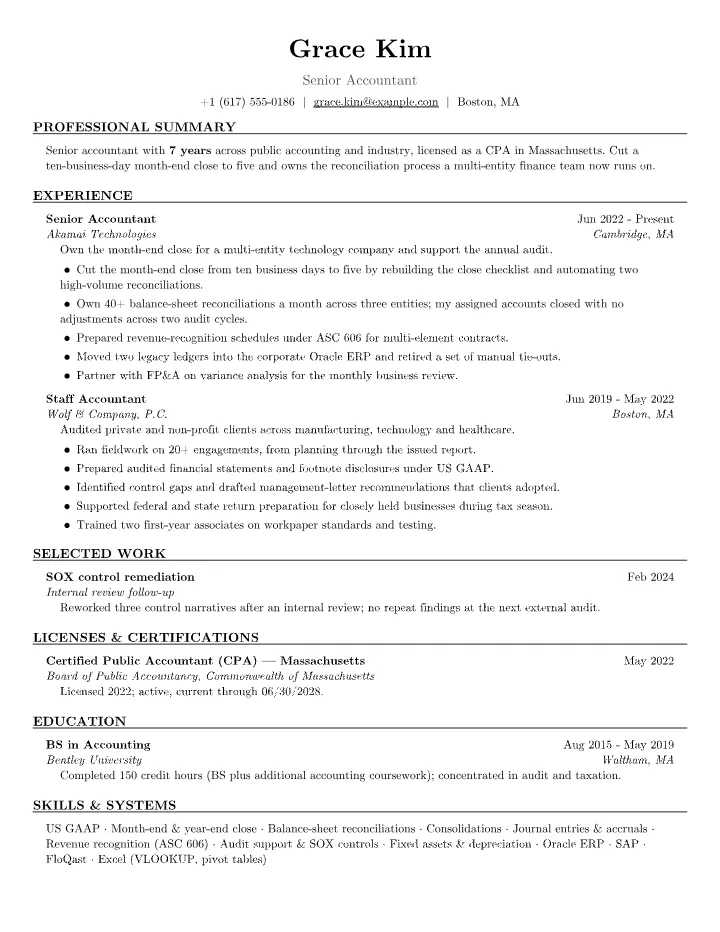
Accountant resume sample — full page preview

Accountant Resume Sample

US sample, set in Massachusetts. Licensure and terminology differ from state to state — this resume follows US conventions.

Open in Editor

Free download · No watermark · No signup

Rendered in the Jake's Resume template · US Letter

Do

  • Lead with the CPA license and its state
  • Name the close cycle: days, entities, accounts
  • Say which ERP you own (NetSuite, SAP)
  • Name the technical areas: ASC 606, consolidations
  • Show audit and SOX control work
  • Quantify time saved and errors reduced

Don't

  • Write "CPA" with no state or expiry
  • List duties without a close-cycle number
  • Claim "$X billion managed" you cannot evidence
  • Name clients whose figures are private
  • Say "familiar with GAAP" and stop there
  • Pad with soft skills a controller ignores

What an accountant resume must show

This is a complete, editable sample for a senior accountant — seven years from an audit floor to owning a company’s close, a Massachusetts CPA, and the reconciliation work described in the numbers a controller checks. Open it, replace the details with yours, and export.

The CPA license, with its state
If you are licensed, the credential carries the most weight on the page — name it exactly, with the issuing state board and the expiry. A CPA license is state-issued, so "CPA" without a state is incomplete.
GAAP fluency, and the hard areas
Revenue recognition, consolidations, leases, fixed assets. Naming the technical areas you own tells a controller which problems you can take off their desk, not just that you "know GAAP".
Close ownership with numbers
How many days the close takes, how many entities, how many accounts you reconcile. The close cycle is the number every finance team tracks, so a before-and-after here is the strongest line on the page.
The systems by name
NetSuite, SAP, Oracle, QuickBooks, Excel. A finance team runs one ERP, and knowing it is often the difference between a ramp-up and a non-starter.
Audit and controls experience
Audit support, SOX controls, management-letter findings. Both the audit years and the industry-side ownership of controls belong on the resume, since each side reads the other as credibility.
Impact in time and money
Close-cycle reduction, hours returned to the team, cost or error reductions. Accounting work is judged on accuracy and efficiency, so quantify both rather than listing the tasks you performed.
Accountant-specific resume tips

Not generic advice — the things that move an accountant application forward.

Put the CPA license and its state up front

For a licensed accountant the credential is the first thing a controller looks for, and it is state-issued — so give the full name, the board and the expiry. If you are still a candidate, say so honestly ("CPA candidate, two sections passed") rather than implying a license you do not hold.

Make the close cycle the headline number

How long the close takes is the metric every finance team tracks. "Cut the month-end close from ten business days to five" says more about your process work than any list of journal entries, and it is the line a hiring manager will ask about first.

Name the technical areas you actually own

Revenue recognition under ASC 606, consolidations, lease accounting, fixed assets. These are the problems a controller is trying to hand off, and naming them positions you against the specific gap in their team rather than as a generalist.

Say which ERP you have run

Finance teams standardize on one system — NetSuite, SAP, Oracle, QuickBooks — and hands-on ownership of that system shortens the ramp. "Led the NetSuite migration for two entities" beats "experience with accounting software".

Show both sides of the audit table

Audit experience and industry-side control ownership each read as credibility to the other. If you started in public accounting, say how many engagements you ran; if you own SOX controls now, say so.

Quantify in time and money, carefully

Close-cycle reduction, hours returned, cost savings, error or adjustment reductions are all fair game. But only if the number is true and you can explain how you measured it — accounting hiring managers will test any figure you put down.

Keep client and employer figures confidential

Do not name a client with non-public figures, or put specific private balances, revenue or losses on the page. Describe your own process and percentage improvements ("cut close time from eight days to five") and anonymize ("a multi-entity technology company").

One page, unless the work earns a second

A controller skims for the CPA line, the close-cycle number and the ERP. If those fill one page, one page is the norm; use a second only if every line carries a result or a licensed credential.

What gets accountant resumes rejected

Each of these reads as a red flag to the person doing the hiring.

"CPA" with no state

A CPA license is issued by a state board, so a bare "CPA" is incomplete and reads as careless in a field built on precision. Give the state and, if you have it, the expiry.

A duty list instead of results

"Prepared journal entries, performed reconciliations, assisted with audits" describes every accountant alive. Without a close-cycle number or a measurable result, there is no reason to pick you over the next resume.

"Familiar with GAAP"

Every applicant knows GAAP. What a controller wants to know is which areas you own — revenue recognition, consolidations, leases — and how deep that ownership goes.

Invented ledger figures

A "$2 billion under management" claim you cannot substantiate falls apart under one interview question, and it undermines the true numbers around it. Use the figures you can actually explain.

Naming clients with private figures

A named client tied to non-public revenue, losses or balances is a confidentiality problem and a professionalism error. Anonymize and generalize; the work matters more than the name.

Certifications that do not fit the role

A certificate from an unrelated field, or a course that does not match the accounting work you are applying for, reads as padding. List the credential that speaks to the job.

Adapting this sample to your specialization

The structure holds across accounting roles — only the credential, the systems and the technical areas change. Find yours and swap them in.

Public accounting / audit
Lead with engagements, industries served and any certifications (CPA). Show team size, client types and the standards you apply; a start date in public accounting reads as training to the industry side.
Tax
Lead with the entities you file for — individual, corporate, partnership, multi-state — and the software (CCH Axcess, UltraTax). Name the complexity you handle, such as multi-state apportionment or pass-through structures.
Corporate / industry
Lead with close ownership, the ERP and the reporting you produce for a controller or CFO. Emphasize process improvement and the month-end handoff to FP&A.
Fund / investment accounting
Lead with the asset classes and the NAV process, the systems (e.g. Investran, Geneva) and the reporting cycles. Name the regulatory context (SEC, investor reporting).
Non-profit / government
Lead with fund accounting, grant reporting and the applicable standards (GAAP for non-profits, single-audit requirements). Emphasize restricted-fund tracking and donor or agency reporting.
Accounts payable / receivable
Lead with volume and accuracy — invoices processed, days payable or receivable, error rates — and the ERP. This is a different focus from the close; consider a dedicated AP/AR sample.
Financial planning & analysis (FP&A)
This is an adjacent career. Lead with forecasting, budgeting and variance analysis and the modeling tools (Excel, Anaplan, Power BI); the accounting foundation becomes supporting context.
CPA candidate / entry-level
Lead with the degree, credit hours and exam progress ("passed AUD and REG; FAR scheduled"), then internships. Be precise about what you hold versus what you are pursuing, and keep it to one page.

The accountant job market

US national figures, each with its source.

$83,680
median annual wage for US accountants and auditors, May 2025 US Bureau of Labor Statistics
115,300
accountant and auditor openings projected each year, on average, 2025–2035 US Bureau of Labor Statistics
150 hours
the college coursework most states require before CPA licensure US Bureau of Labor Statistics
55,152
US accounting graduates in 2023–24, down 6.6% year on year as demand holds AICPA

Accountant resume FAQs

Do I need a CPA to work as an accountant?

Not always. A CPA license is state-issued and often required or preferred for public accounting and senior roles, but many industry accounting jobs hire on a degree and experience alone. Say plainly whether you are licensed, a candidate, or neither.

Source: US Bureau of Labor Statistics

How do I put a CPA license on my resume?

Write "CPA — <state>" with the issuing board and the expiry, because the credential is state-issued. If you have not passed all four sections yet, say "CPA candidate" and which sections are done — never ", CPA" after your name.

Do I need 150 credit hours to be an accountant?

Most states require 150 semester hours of college coursework before you can be licensed as a CPA. You can usually sit the exam earlier, but the license needs the full 150, so state your credit hours if you are early-career.

Source: US Bureau of Labor Statistics

Can I name clients on an accounting resume?

Only if you are cleared to, and never with their private figures. anonymize and generalize — "a multi-entity technology company" — and describe your own process and percentage improvements rather than a client’s balances, revenue or losses.

Which software should an accountant list?

Excel plus the ERP you have actually run: NetSuite, SAP, Oracle or QuickBooks. Finance teams standardize on one system, and hands-on ownership of it shortens your ramp, so name it rather than saying "accounting software".

How long should an accounting resume be?

One page is standard for a mid-level accountant; use a second only if every line carries a result or a licensed credential. Length is not the problem; padding is.

Plain-text version

Prefer to start from text? Copy this sample and paste it into any editor.

Grace Kim
Senior Accountant
[email protected] | +1 (617) 555-0186 | Boston, MA

PROFESSIONAL SUMMARY
Senior accountant with 7 years across public accounting and industry, licensed as a CPA in Massachusetts. Cut a ten-business-day month-end close to five and owns the reconciliation process a multi-entity finance team now runs on.

EXPERIENCE
Senior Accountant — Akamai Technologies
Jun 2022 – Present | Cambridge, MA
Own the month-end close for a multi-entity technology company and support the annual audit.
• Cut the month-end close from ten business days to five by rebuilding the close checklist and automating two high-volume reconciliations.
• Own 40+ balance-sheet reconciliations a month across three entities; my assigned accounts closed with no adjustments across two audit cycles.
• Prepared revenue-recognition schedules under ASC 606 for multi-element contracts.
• Moved two legacy ledgers into the corporate Oracle ERP and retired a set of manual tie-outs.
• Partner with FP&A on variance analysis for the monthly business review.

Staff Accountant — Wolf & Company, P.C.
Jun 2019 – May 2022 | Boston, MA
Audited private and non-profit clients across manufacturing, technology and healthcare.
• Ran fieldwork on 20+ engagements, from planning through the issued report.
• Prepared audited financial statements and footnote disclosures under US GAAP.
• Identified control gaps and drafted management-letter recommendations that clients adopted.
• Supported federal and state return preparation for closely held businesses during tax season.
• Trained two first-year associates on workpaper standards and testing.

SELECTED WORK
SOX control remediation — Internal review follow-up
Feb 2024
Reworked three control narratives after an internal review; no repeat findings at the next external audit.

LICENSES & CERTIFICATIONS
Certified Public Accountant (CPA) — Massachusetts — Board of Public Accountancy, Commonwealth of Massachusetts
May 2022
Licensed 2022; active, current through 06/30/2028.

EDUCATION
BS in Accounting — Bentley University
Aug 2015 – May 2019 | Waltham, MA
Completed 150 credit hours (BS plus additional accounting coursework); concentrated in audit and taxation.

SKILLS & SYSTEMS
US GAAP · Month-end & year-end close · Balance-sheet reconciliations · Consolidations · Journal entries & accruals · Revenue recognition (ASC 606) · Audit support & SOX controls · Fixed assets & depreciation · Oracle ERP · SAP · FloQast · Excel (VLOOKUP, pivot tables)

Your next resume, in minutes.

Free to build, free to export, free forever. No sign-up needed to begin.

No credit card · No watermark · Unlimited exports