What a software engineer resume must show
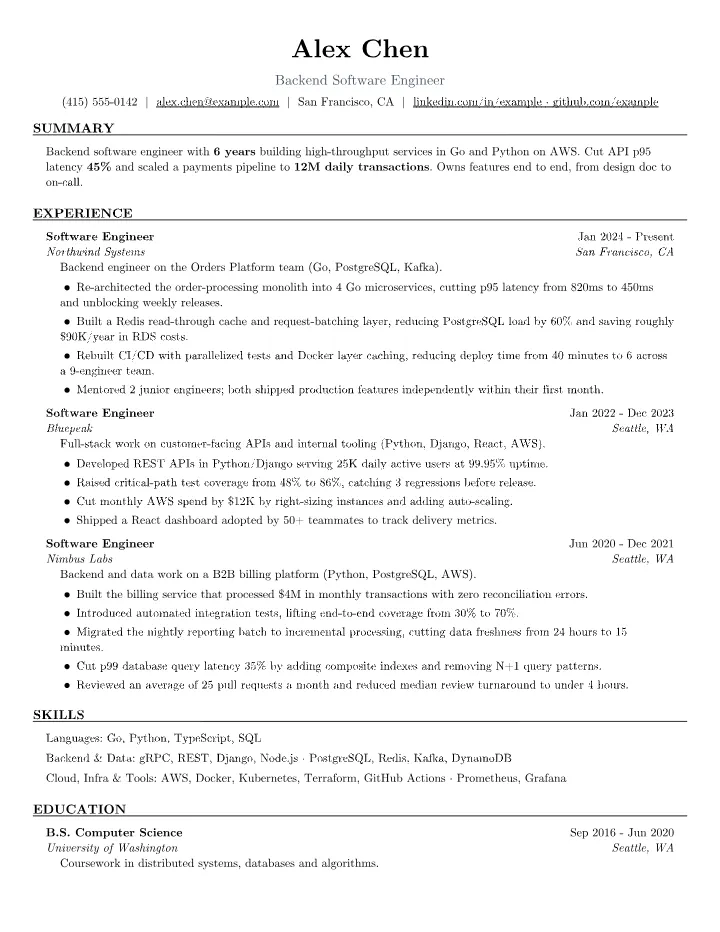
This is a complete, editable sample for a backend software engineer with about six years of experience. Every bullet names the system, the change and the result — latency cut, database load reduced, deploy time shortened — and it fits on one clean, single-column page. Open it, replace the details with yours, and export.
- Impact with a number, on every bullet
- Latency (before → after), throughput, uptime, error rate, infrastructure cost, users served. "Cut p95 latency from 820ms to 450ms" tells a hiring manager far more than "improved performance", and it is the fastest way past the seven-second scan.
- The stack, named exactly
- Languages, frameworks, datastores and cloud, written the way a job posting writes them (say "PostgreSQL", not "SQL databases"). Recruiters look at stack fit first, so make the match obvious.
- Scale you worked at
- Daily active users, requests per second, data volume, team size. Scale is what separates a mid-level resume from a junior one, and it is one of the three things engineering managers look for in the first ten seconds.
- Ownership, not participation
- Lead with what you designed, architected or owned end to end. "Re-architected … into 4 microservices" reads as a decision; "worked on microservices" reads as attendance.
- A GitHub link in the contact line
- Recruiters for engineering roles look for a code profile. Put GitHub (and a portfolio, if you have one) beside your email and phone — one line, always visible, no hunting.
- Education, condensed to a line or two
- Degree, institution and year. Once you have real experience, coursework matters less than the systems you shipped; keep education to a single entry and put the space into your strongest role.
Software Engineer-specific resume tips
Not generic advice — the things that move a software engineer application forward.
Quantify the outcome, not the task
Every "what I did" needs a "what changed". The pattern engineers should follow is action verb → what you did → how → measurable result. "Added a Redis read-through cache, reducing database load 60% and saving ~$90K/year" beats "worked on caching" every time.
Use the metrics engineering managers actually read
For backend and infrastructure work that means latency (p50/p95/p99 with a before and after), throughput, uptime or error rate, infrastructure cost, and scale — users, requests, data volume. If you genuinely cannot measure the outcome, quantify the effort instead: services migrated, records processed, tests written, PRs reviewed.
Dream in before → after
A single before-and-after pair is the highest-signal thing on the page: "deploy time 40 min → 6 min", "coverage 48% → 86%", "p99 320ms → 84ms". If you only have one number, say what it replaced.
Match the stack to the posting — exactly
Screens and recruiters filter on the tools named in the job description. If the posting says "PostgreSQL" and "Go", write those words, not "relational databases" and "backend languages". Depth beats breadth: list the six to nine technologies you can defend in an interview, not twenty you touched once.
Make the summary earn its place
A summary is optional at mid-level — include one only if it adds information the bullets do not. Keep it to two or three lines and lead with measured impact ("cut API p95 latency 45%, scaled a payments pipeline to 12M daily transactions"), never an objective like "seeking a challenging role".
Show ownership to read as senior-ready
Verbs like architected, led, designed and mentored signal that you own systems, not tickets. Add team scope — "across a 9-engineer team", "mentored 2 juniors" — because owning work beyond your own tasks is what a promotion decision turns on.
One page, single column, no graphics
Recruiters skim in seconds and read text, not decoration. Tables, columns, icons and skill bars take up space without adding signal. One page per decade of experience; for most engineers a tight one-pager beats a padded two.
What gets software engineer resumes rejected
Each of these reads as a red flag to the person doing the hiring.
Duties with no outcomes
"Wrote code, fixed bugs, attended stand-ups" describes every engineer alive. If every bullet could belong to anyone, there is no reason to interview you — the number is what makes a bullet yours.
A dump of every technology you have touched
Long, undifferentiated skill lists dilute the keywords that actually match the role and signal shallow exposure. List the handful you can discuss deeply, grouped by category.
A generic summary or objective
"Seeking a challenging role to grow my skills" occupies the highest-attention zone on the page and says nothing. Mid-level resumes should lead with experience, not an objective.
No scale or ownership
A resume that never says how many users, how much traffic or what you owned reads as junior, however many years it lists. Scale and ownership are the two things that make a mid-level engineer look ready for the next level.
A layout that cannot be parsed
Multi-column templates, sidebars and graphics look polished but read badly: job titles get mixed with skills and dates detach from the roles they belong to, so the first impression is a muddle rather than a career.
Software Engineer resume FAQs
How long should a software engineer resume be?
One page for most engineers, and up to two once you have roughly eight or more years of experience. Recruiters skim the first page in seconds, so a tight, quantified one-pager beats a padded two-pager. Add a second page only when every line carries a result rather than a duty.
What should a software engineer resume include?
Your experience with quantified impact, the exact stack named in the job posting, a short projects section with repo links, a grouped skills list, and a condensed education line. For a mid-level engineer there is no summary — experience leads the page.
Do software engineers need a degree?
A bachelor’s degree is the typical entry-level education for software developers, but it is not an absolute requirement. What the resume must prove either way is that you have shipped working software, with the impact measured.
Source: US Bureau of Labor Statistics — Software Developers
How do I quantify impact on a software engineer resume?
Use the metrics engineering teams already track: latency (before → after), throughput, uptime or error rate, infrastructure cost, and scale such as users or requests per day. If no outcome metric exists, quantify the effort — services migrated, tests written, PRs reviewed — rather than reaching for "significantly improved".
Should a software engineer resume have a summary?
A short one is fine if it adds information the bullets do not — two or three lines that lead with measured impact. Skip it if it would only restate your title or say you are "passionate about technology", and never use an objective.
How many programming languages should I list?
Six to nine you can genuinely discuss in an interview, grouped by category (languages, backend, data, cloud). A long, undifferentiated list signals shallow exposure and dilutes the keywords that match the role — depth beats breadth.
Plain-text version
Prefer to start from text? Copy this sample and paste it into any editor.
Alex Chen
Backend Software Engineer
[email protected] | (415) 555-0142 | San Francisco, CA | linkedin.com/in/example · github.com/example

SUMMARY
Backend software engineer with 6 years building high-throughput services in Go and Python on AWS. Cut API p95 latency 45% and scaled a payments pipeline to 12M daily transactions. Owns features end to end, from design doc to on-call.

EXPERIENCE
Software Engineer — Northwind Systems
Jan 2024 – Present | San Francisco, CA
Backend engineer on the Orders Platform team (Go, PostgreSQL, Kafka).
• Re-architected the order-processing monolith into 4 Go microservices, cutting p95 latency from 820ms to 450ms and unblocking weekly releases.
• Built a Redis read-through cache and request-batching layer, reducing PostgreSQL load by 60% and saving roughly $90K/year in RDS costs.
• Rebuilt CI/CD with parallelized tests and Docker layer caching, reducing deploy time from 40 minutes to 6 across a 9-engineer team.
• Mentored 2 junior engineers; both shipped production features independently within their first month.

Software Engineer — Bluepeak
Jan 2022 – Dec 2023 | Seattle, WA
Full-stack work on customer-facing APIs and internal tooling (Python, Django, React, AWS).
• Developed REST APIs in Python/Django serving 25K daily active users at 99.95% uptime.
• Raised critical-path test coverage from 48% to 86%, catching 3 regressions before release.
• Cut monthly AWS spend by $12K by right-sizing instances and adding auto-scaling.
• Shipped a React dashboard adopted by 50+ teammates to track delivery metrics.

Software Engineer — Nimbus Labs
Jun 2020 – Dec 2021 | Seattle, WA
Backend and data work on a B2B billing platform (Python, PostgreSQL, AWS).
• Built the billing service that processed $4M in monthly transactions with zero reconciliation errors.
• Introduced automated integration tests, lifting end-to-end coverage from 30% to 70%.
• Migrated the nightly reporting batch to incremental processing, cutting data freshness from 24 hours to 15 minutes.
• Cut p99 database query latency 35% by adding composite indexes and removing N+1 query patterns.
• Reviewed an average of 25 pull requests a month and reduced median review turnaround to under 4 hours.

SKILLS
Languages: Go, Python, TypeScript, SQL
Backend & Data: gRPC, REST, Django, Node.js · PostgreSQL, Redis, Kafka, DynamoDB
Cloud, Infra & Tools: AWS, Docker, Kubernetes, Terraform, GitHub Actions · Prometheus, Grafana

EDUCATION
B.S. Computer Science — University of Washington
Sep 2016 – Jun 2020 | Seattle, WA
Coursework in distributed systems, databases and algorithms.